

Colloidal Solids
The Colloidal Solids instrument is an European Space Agency (ESA) facility developed to perform a series of soft matter experiments inside NASA’s
Microgravity Science Glovebox (MSG) inside the International Space Station (ISS).
The experiment series aim to investigate the origin, formation and dynamics of colloidal crystals, glasses, and gels, and nucleation in protein solutions. European Space Agency (ESA) project on Material Science performed in the Microgravity Science Glovebox (MSG), a National Aeronautics and Space Administration (NASA) facility.
- Colloids – Glass transition, gels and attractive glasses in colloidal systems (GLASS and GEL)
- Proteins – Controlled nucleation and crystal quality under different mass transport regimes (PROTEINS)
Significant Dates
Experiment/payload description and objectives
The ISS microgravity condition allows Colloidal Solids to study colloidal and protein systems free from sedimentation and natural convection, so that their structural and dynamical evolution develops under purely diffusive conditions.
The instrument is an optical diagnostics facility that, utilizing advanced light scattering, enables the observation of colloidal suspensions and protein solutions confined in experimental cells, allowing the investigation of glass transition, gel formation and nucleation processes with high spatial and temporal resolution. Find more details in the related science publication.
Different samples have been studied:
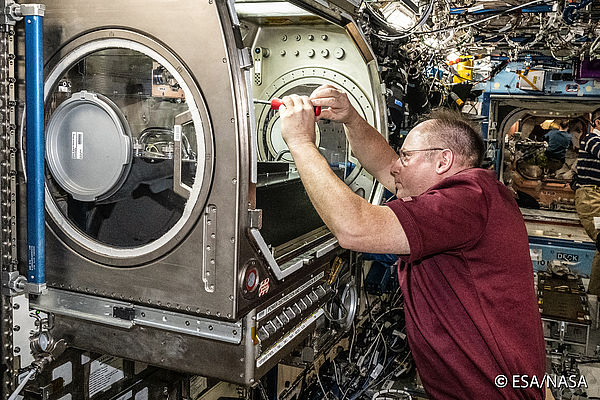

Source: NASA
Glass & Gel samples
The study focuses on the glass transition in hard-sphere systems, specifically PMMA particles dispersed in different solutions, as well as water-based suspensions of perfluorinated polymer colloidal particles. The investigation focuses on the role of dynamical heterogeneities and the evolution with ageing of newly introduced quantities like the four-point correlation function and the dynamical susceptibility. The main objective is to determine whether equilibrium glasses exist and, if so, their steady-state properties.
In line with this objective, the colloids part of the experiments will also investigate gels and attractive glasses in a weakly attractive system of colloidal particles and polymers. The samples include gels and attractive glasses in a suspension of PMMA and non-adsorbing polymer in decalin/tetralin solution. As before, the analysis will focus on dynamical heterogeneities and on mapping phase diagrams across different ranges of the attractive potential.
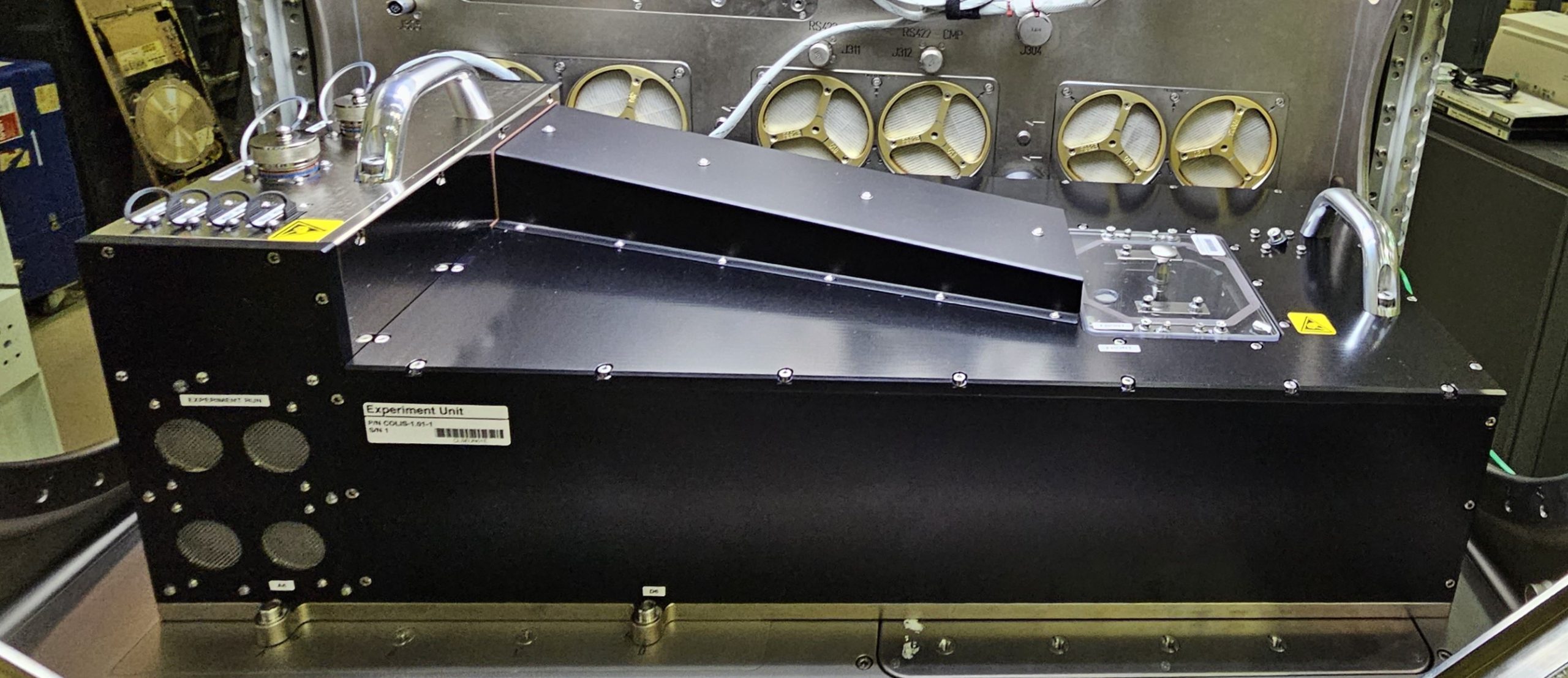
Source: ESA
Proteins sample
The scientific goals involve gaining insights on the improvement of crystal quality by controlled nucleation via solution flow. Particularly, the effect of the mass transport regime on the characteristics of the nucleation precursors, on the nucleation itself and the nucleation induction time are to be studied. Additionally, the research will delve on the evolution of the nucleation precursors during the nucleation process, on the effect of impurities on the nucleation induction times in the different mass transport regimes studied and the behaviour of proteins with different degrees of stability.